Editor's Note - Aligning Grassroots Collective Care with Global Priorities: Why the Ubuntu Healing Initiative is the Local Blueprint for MoH Kenya, UNICEF, and WHO Agendas
By The Correspondent team. 29th August 2026
Introduction: The Imperative for a Right-Based, Community-Integrated Architecture
Global health architectures are undergoing a fundamental paradigm shift. For decades, mental health care and psychosocial support systems in Sub-Saharan Africa operated within rigid, centralized, and hyper-biomedical models inherited from colonial-era legal instruments. These custodial frameworks effectively pathologized psychological suffering, prioritizing social isolation and institutional containment over community-integrated restoration.

Today, this institutional legacy faces intense criticism from international bodies and local policy leaders alike. The World Health Organization’s (WHO) World Mental Health Report: Transforming Mental Health for All explicitly calls upon member states to dismantle centralized structures in favor of decentralized, community-based care networks.
Concurrently, the Kenyan Ministry of Health (MoH), through the rollout of the Kenya Mental Health Action Plan (2021–2025) and the integration of specialized mental health services into the Social Health Authority (SHA) national insurance package under the Taifa Care Model, has positioned localized primary healthcare as the bedrock of Universal Health Coverage (UHC).
Yet, translating these high-level policies into reality is hindered by structural limitations. Kenya faces a critical shortage of psychiatric professionals. This workforce deficit is compounded by deep public stigma, widespread substance use disorders, and pervasive socioeconomic vulnerabilities, including Gender-Based Violence (GBV), child labor, child trafficking, and institutional neglect.
As the Editor-in-Chief of the Ubuntu Healing Initiative (UHI), I assert that our Community-Based Organization provides the exact operational blueprint required to bridge this macro-policy gap. Grounded firmly in the indigenous African philosophy of Ubuntu—“I am because we are”—UHI operates not as a clinical silo, but as a multi-disciplinary network. Our work is structurally aligned with MoH agendas, UNICEF's child protection protocols, and WHO’s mandates for vulnerable and displaced populations.
By embedding trauma-informed education, professional counseling, and systemic advocacy directly into spaces like classrooms and community networks, UHI translates global targets into localized, measurable social transformation.
The UHI Conceptual Framework: Four Core Themes Informing Trauma and Counseling

To provide scholars, development partners, and policy-makers with an operational framework, UHI organizes its trauma-informed counseling, clinical interventions, and field training under four distinct, interconnected theoretical themes.
Theme 1: Indigenous Collective Care and Cultural Psychosocial Interconnectedness
Traditional Western psychological approaches focus heavily on intrapsychic processes, treating the individual in isolation from their sociopolitical reality. UHI deconstructs this limitation by anchoring its counseling model in the African ethos of Ubuntu.
We recognize that individual psychological trauma is intrinsically linked to collective community fragmentation. When a child experiences domestic abuse or a refugee woman navigates displacement, the entire social fabric suffers.

UHI’s counseling modalities utilize group-based containment, peer-support networks, and community sensitization forums. This cultural framing removes the stigma associated with psychiatric diagnoses, repositioning mental wellness as a shared societal resource.
Theme 2: Trauma-Informed Pedagogical Environments and Child Protection
Millions of children across East Africa enter classrooms carrying the invisible weight of trauma induced by extreme poverty, domestic violence, child labor, and structural neglect. Standard educational systems often misinterpret the behavioral expressions of a dysregulated nervous system as willful misconduct, responding with counter-productive punishment.
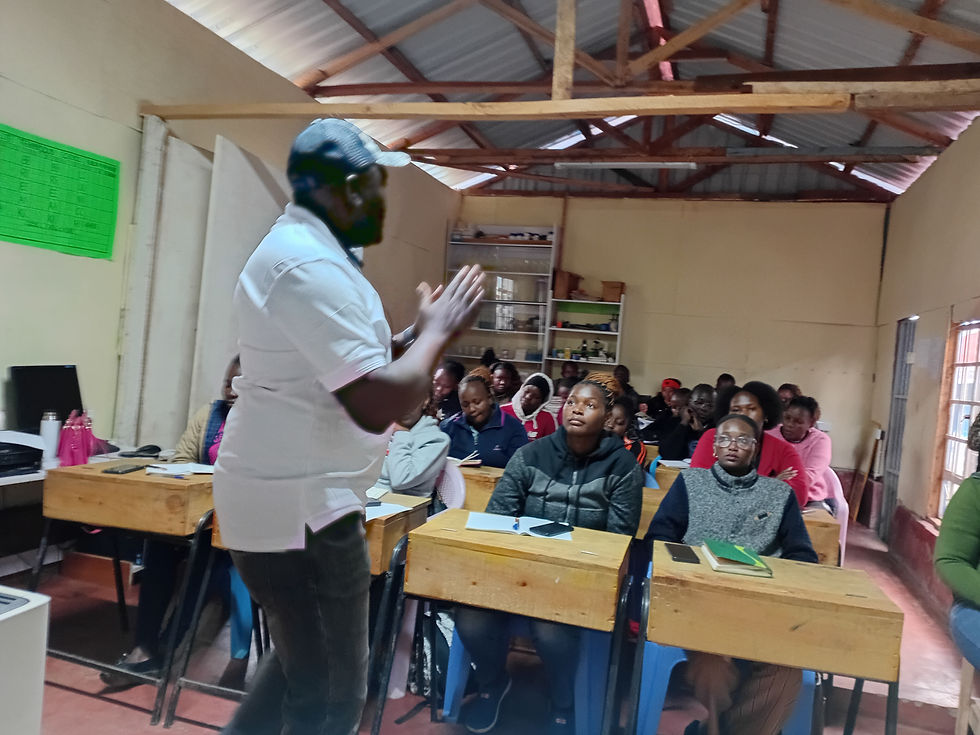
UHI alters this cycle by introducing Trauma-Informed Education (TIE) modules directly into learning institutions, including Elite Tremendous School and Precious Kids Academy. Our counselors equip teachers with Psychological First Aid (PFA) and crisis de-escalation skills.
This directly advances UNICEF’s global mandate to build non-violent, protective, and inclusive schools that safeguard children from trafficking and exploitation.
Theme 3: Developmental Resilience, Mentorship, and Substance Abuse Prevention
Adolescence in urban and peri-urban Kenyan settlements represents a developmental window marked by heightened vulnerability to anti-social behaviors, economic exploitation, and Substance Use Disorders (SUDs).
UHI addresses this risk through its Youth Mentorship Programme, which combines structured life-skills training, cognitive-behavioral tools, and career guidance. By proactively fostering emotional resilience, UHI targets the underlying psychological distress that frequently drives substance abuse.
This preventive approach addresses the core concerns outlined in the Kenya Mental Health Investment Case, which highlights substance abuse as a major drain on national productivity and socioeconomic development.
Theme 4: Systemic Advocacy, Human Security, and Intersectional Inclusion
Psychological trauma does not exist in a vacuum; it intersects with legal, economic, and gender-based disparities. UHI’s fourth theme centers on establishing safe spaces specifically for women, adolescent girls, and displaced refugees who have survived intersectional violence.
By conducting local Adverse Childhood Experiences (ACEs) surveys and institutional needs assessments, UHI generates empirical data from the field. This bottom-up research provides a concrete evidence base to support national human rights advocacy and influence gender-equity policies, aligning directly with WHO and UN priorities.
The Family Medicine Approach to Complex Community Needs: The UHI Systemic Solution
To address complex, multi-layered social challenges like child exploitation, gender-based trauma, and addiction, interventions must move beyond isolated clinical treatments. This alignment is where UHI integrates a Family Medicine Approach to Complex Needs, a methodology championed globally by institutions like the University of Edinburgh and grounded in foundational primary care theory.
Ian McWhinney and Thomas Freeman, pioneers of modern family medicine, argued that the physician or healthcare practitioner must understand the context of the illness, viewing the patient not merely as a biological host for a disease, but as an inseparable part of a dynamic family and community system.

This systemic lens is central to how UHI operates. When our team addresses substance abuse or trauma in locations like Kiambu or Nairobi, we do not limit our response to the individual client. Our clinical services division actively pulls in the entire family unit through structured family and marriage counseling, recognizing that sustainable individual recovery requires a supportive domestic environment.
Furthermore, our operational model embodies the "Five-Star Doctor" framework conceptualized by Charles Boelen for the World Health Organization. Boelen posited that to achieve universal, equitable health outcomes, frontline health professionals must concurrently fulfill five distinct roles:
Care Provider: Delivering high-quality, trauma-informed, and compassionate therapy.
Decision Maker: Utilizing evidence-based research, ACEs surveys, and localized data to allocate resources ethically and effectively.
Communicator: Harmonizing public awareness campaigns to demystify mental illness across schools and workplaces.
Community Leader: Building trust and mobilizing local structures to foster a shared sense of program ownership.
Manager: Establishing robust multi-sectoral partnerships with academic institutions like USIU-Africa, international organizations, and government entities to scale impact sustainably.

By structuring UHI around these precise roles, our organization serves as an effective operational arm for the Kenyan state’s Universal Health Coverage goals. We expand the reach of digitally empowered Community Health Promoters (CHPs) by providing them with specialized mental health literacy and psychological first aid toolkits.

When academic scholars, development partners, and global health strategists examine UHI’s departmental framework, they find a validated model for primary health integration. We demonstrate that the compounding wounds of child abuse, trauma, and neglect can be treated effectively when global policy indicators are paired with indigenous, community-led care systems.
Join the Global Network for Mental Health Transformation
The evidence is undeniable: there can be no sustainable socioeconomic development without comprehensive mental health infrastructure. The Ubuntu Healing Initiative is proud to lead this rights-based, trauma-informed transformation across Kenyan communities. We invite researchers, policymakers, and global advocates to utilize our structural models and join our growing movement.
Subscribe to our publication platform today to receive our latest empirical field reports, theoretical updates, and direct notifications for upcoming training opportunities straight to your inbox. Let us advance the science and practice of collective care together.
By Benard Chinua, Editor-In-Chief and UHI Correspondent.
References
Boelen, C. (1996). The Five-Star Doctor: An asset to primary health care. World Health Organization.
Kamundia, M., & Ombati, E. (2023). Beyond custodial containment: The urgent need for rights-based legal reform in Kenyan mental health systems. African Journal of Disability, 12(2), 114–125.
McWhinney, I. R., & Freeman, T. (2016). Textbook of Family Medicine (4th ed.). Oxford University Press.
Ministry of Health, Republic of Kenya. (2021). Kenya Mental Health Action Plan (2021-2025). Government Printer.
Ministry of Health, Republic of Kenya. (2021). The Kenya Mental Health Investment Case. World Health Organization & Ministry of Health.
Mwangangi, M., & Karanja, M. (2026). Decentralization and programmatic integration of maternal-child mental wellness within primary care systems. East African Medical Journal, 103(4), 210–222.
World Health Organization. (2022). World mental health report: Transforming mental health for all. World Health Organization.


Comments